Stability and Shelf-Life Testing for Hotel Fragrance Lines: What Changed
The principle of stability testing has not changed — prove the product stays within specification across its declared life — but the stresses have. Refill formats, water-based mists, recycled plastics and longer shipping routes all broke the old assumption that a room-temperature sample opened six months later told you enough. For a spa or hotel programme that buys in volume, the practical response is not more tests; it is better targeted ones.
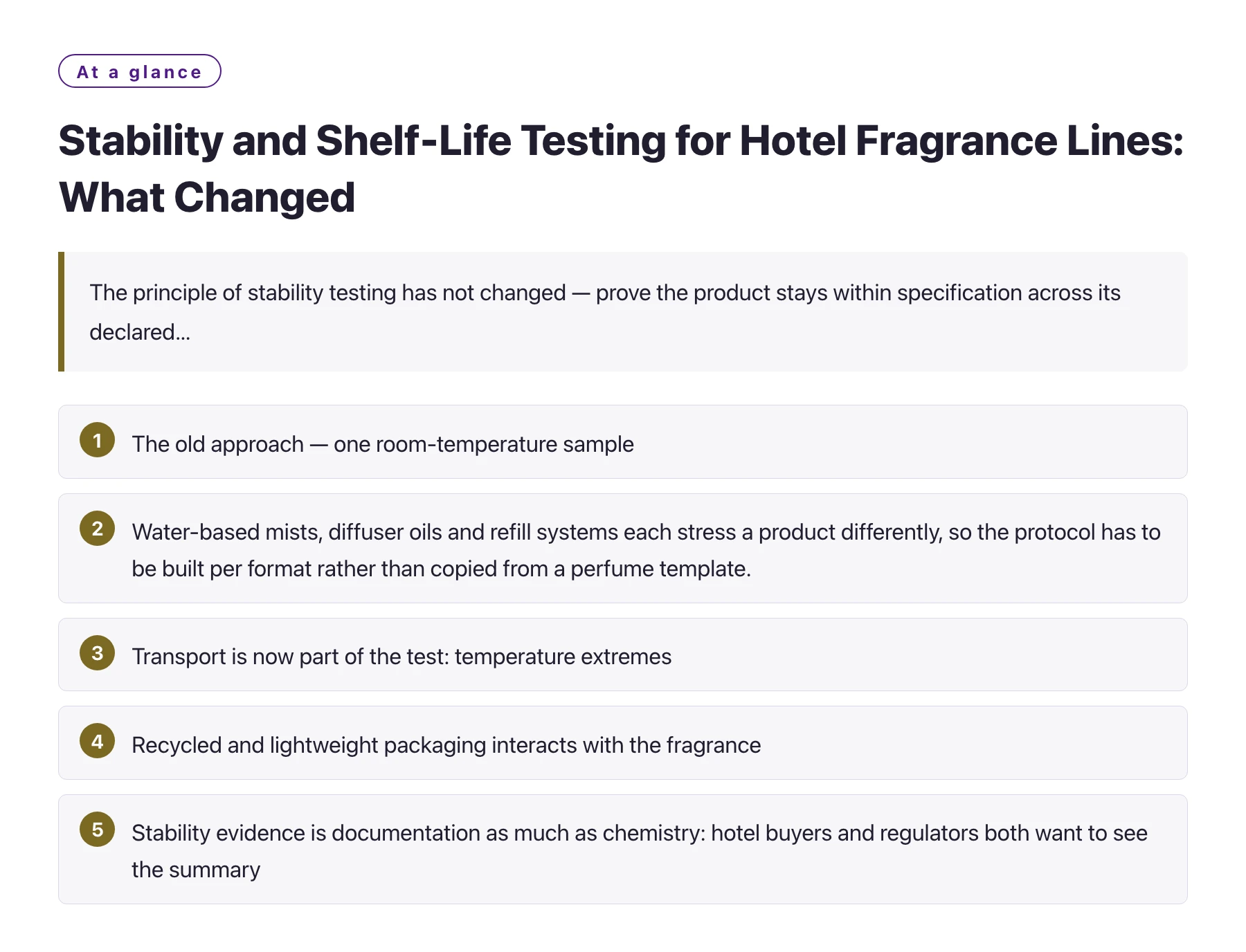
Key takeawaysThe old approach — one room-temperature sample, one look at six months — no longer covers the formats and shipping routes hotel lines actually use. · Water-based mists, diffuser oils and refill systems each stress a product differently, so the protocol has to be built per format rather than copied from a perfume template. · Transport is now part of the test: temperature extremes, vibration and long container routes can age a product faster than twelve months on a shelf. · Recycled and lightweight packaging interacts with the fragrance, so packaging compatibility belongs inside the stability programme, not outside it. · Stability evidence is documentation as much as chemistry: hotel buyers and regulators both want to see the summary, and the summary is only as good as the test conditions behind it.
Buyers for hotels and spas order in volumes that make a bad batch expensive: one compromised run means hundreds of rooms and dozens of amenity kits with a scent that has turned, and the complaint arrives long before the container's paperwork does.
For years, stability in practice meant storing a sample at room temperature and opening it later. This article looks at what has changed around that test — formats, materials, transport and scrutiny — and gives a protocol a spa or hotel programme can actually run.
The principle that has not changed
Stability testing is still a controlled ageing exercise: define the conditions, take measurements at defined timepoints, and conclude how long the product can be expected to stay within specification under normal use. The trade association guidance the cosmetics industry works from still organises the test this way, and it is the basis for the stability evidence regulators expect to see in a product file [1].
What that guidance cannot do is pick the conditions for you. A perfume for boutique retail and a diffuser oil for a hotel lobby withstand different realities, and the range of formats brands now ship reflects consumer behaviour that market research tracks closely [2]. The protocol therefore has to be justified by the product, not copied from a neighbour's.
The protocol a spa or hotel line should actually run
- Map the real conditionsList where the product will live — lobby heat, bathroom humidity, luggage transport, linen-room storage — and turn each one into a test condition.
- Choose the storage temperaturesCold (4°C), ambient (25°C) and elevated (40°C) are the common set; add freeze-thaw only if the product will actually freeze.
- Set timepoints and measuresTest at zero, one, three and six months at minimum; measure appearance, colour and odour of the concentrate and the finished product, plus weight loss for volatile formats.
- Test the packaging, not just the liquidThe bottle, cap, pump or diffuser reed interacts with the fragrance, so a filled, closed, labelled unit belongs inside the test.
- Simulate transportA short vibration and temperature-cycle check surfaces what a container route will do; this is where many water-based formats are actually lost.
- Keep the referee sampleA sealed sample from the launch batch, stored separately, is the comparison point whenever a later unit is questioned.
What changed in recent years
| Aspect | Classic practice | What changed recently |
|---|---|---|
| Formats | Perfume spray as the default | Mists, diffuser oils, solids and alcohol-free formats with different evaporation and separation profiles |
| Packaging | Glass and long-run stock bottles | Recycled plastics, lightweight walls and refill systems whose materials interact differently with the fragrance |
| Transport | Short, temperate distribution | Long container routes, temperature extremes and last-mile storage the product was never designed for |
| Consumer scrutiny | A storage note on the box | Buyers and guests check PAO dates, expiry claims and sustainability stories, so the label has to be true |
| Documentation | A stability note kept on file | A stability summary is routinely requested in hotel tenders and importer compliance packs |
The table is not a list of new tests; it is a list of new stresses that make the same tests worth running properly.
Why hotels and spas feel every change first
Hotel and spa programmes buy large same-batch volumes, place products in uncontrolled spaces and reorder against a fixed season. That combination turns an average stability profile into a visible problem faster than almost any retail category. A spa line with a six-month shelf life and a nine-month buying cycle is a product whose label contradicts its logistics.
For these programmes, manufacturing under one roof has a practical benefit: if compounding, filling and finishing happen in the same plant under the same documentation, the stability file refers to one controlled process rather than a chain of subcontractors fragrance manufacturing under one roof. That makes the evidence easier to trust and easier to repeat on every reorder.
Asking a manufacturer for stability evidence
Ask for the stability summary before you negotiate price. A reasonable supplier can share the test conditions, the timepoints and the conclusion without revealing the formula, and the format of that summary tells you whether stability is routine or improvised.
Then ask the question that separates depth from decoration: what happens to the concentrate during maturation, and how does the finished-product test relate to it? Concentrate behaviour and finished-product behaviour are different problems, and a supplier that can explain both is describing process rather than marketing.
Production history is a legitimate check here, because stability failures repeat in known patterns across formats. A manufacturer that has compounded and filled fragrances for years — a 31-year-old fragrance manufacturer in China, for instance — has usually collected those patterns into its protocol before you ever ask a 31-year-old fragrance manufacturer in China.
If the supplier develops the scent itself rather than filling to your formula, the same evidence applies: an existing base with a known stability profile is part of the reason many hotel programmes start from an ODM shelf instead of a bespoke formula. It is worth asking which bases come with stability data attached scent development and manufacturing partner.
Sources
- Cosmetics Europe —— The European trade association for the cosmetics and personal care industry, publishing guidance, positions and market information.
- Mintel Press Centre —— Mintel's press releases on consumer and beauty market research, including fragrance and personal care trend reporting.
Frequently asked questions
How long does a stability test take?
A realistic minimum is three months of storage time for a screening conclusion, and six months or more for a shelf-life basis, because the elevated-temperature data has to be read against the ambient data. Accelerated conditions shorten the wait but do not replace real-time evidence.
Can accelerated testing replace a real-time test?
Elevated-temperature data at 40°C is a useful early screen and often the first thing a supplier shows you, but it cannot fully replace real-time storage, especially for volatile and water-based formats where the failure mode is evaporation or separation.
Who owns the stability data?
Usually the manufacturer, as part of the product file, with the brand holding the summary and the conclusion. If the formula is yours under an OEM arrangement, negotiate in advance that the stability evidence stays available to you if you change manufacturers.
What does PAO mean on a hotel product?
PAO stands for period after opening — the time the product stays within specification after first use. For hotel formats that are used and refilled, the PAO and the refill policy should be decided together, because a refill system that is never cleaned changes the real shelf life.
Does a diffuser oil need stability testing?
Yes, but with different measures: weight loss and evaporation rate matter more than colour, and the oil's interaction with reeds, wicks and the bottle material is the main risk. A diffuser test is packaging-heavy and evaporation-focused rather than a copy of a spray test.