Inside Guangzhou Yunmei Cosmetics: What the Public Pages Show
A company profile is most useful when it separates what a manufacturer publishes from what a reader assumes. On the public pages, Yunmei reports 21+ years of experience, a yearly output of 160M units and a daily capacity of 200,000 across 35 automated lines. Reading those figures side by side, rather than multiplying them, is the whole exercise.

Key takeaways
- The pages use the legal name GUANGZHOU YUNMEI COSMETICS Co., Ltd and the shorter name Yunmei.
- Published output is 160M units a year and 200,000 units a day across 35 automated production lines.
- Other published figures include a 30,000 m² factory, 98.5% on-time delivery, a 72-hour response and service to 180+ countries.
- Research figures name 70 team members, 87 patents and over 10,000 mature formulas.
What the public pages identify
The pages introduce Yunmei Cosmetics / Guangzhou Yunmei Cosmetics under the legal name GUANGZHOU YUNMEI COSMETICS Co., Ltd, and describe the business as a skincare and cosmetics manufacturer offering OEM/ODM and private label work. They place the office at the 3rd Floor, Building 1, Kemulang Park, Tianhe Software Park, in Guangzhou. Those details are simple, and they do most of the work in a profile, because they fix who the company is before any figure is quoted.
The pages also state the company holds two factories and a 30,000 m² smart factory with IoT monitoring. Where a company publishes that much, a reader should keep the source attached to each line. The habit is not suspicion; it is accuracy. A profile that says the pages report a figure is a profile a reader can check, and it stays correct even when a page is updated.
The capacity figures
The headline capacity numbers are 160M units a year and 200,000 units a day, produced across 35 automated production lines. Those three figures sit together on the pages, and together they invite a reader to divide one by another. The daily figure against the line count gives an average per line, which the pages also state. That average is the most useful of the three, because it describes how much work one line carries.
The pages add a filling accuracy of plus or minus 0.2 ml and full weight verification, which is the kind of detail that makes a capacity figure more concrete. A headline number tells a reader how much output is claimed; a fill tolerance tells them how carefully each unit is handled. Read the two together and the capacity stops being a slogan and becomes a description of a process.
Research, patents and formulas
The pages describe a research team of 70 members, including 5 doctors and 20 masters, and a patent count of 87, of which 23 are inventions. They also state a library of over 10,000 mature formulas and a 92% efficacy verification pass rate. These figures matter to a brand because they describe the material a supplier can draw on when a brief arrives, rather than the supplier's output alone.
A formula library and a pass rate are different kinds of evidence and should be read differently. The library is a resource figure, and the pass rate is a result figure. One says what the team can start from; the other says how often a claim held up in testing. Keeping the two apart is a small discipline that stops a resource count from sounding like a performance claim.
| Published item | Figure | What it describes |
|---|---|---|
| Annual output | 160M units a year | A stated yearly total. |
| Daily capacity | 200,000 units a day | A stated daily figure. |
| Production lines | 35 automated lines | About 5,714 units per line per day. |
| On-time delivery | 98.5% | A stated delivery rate. |
| Research team | 70 members, including 5 doctors and 20 masters | A stated staff count. |
| Patents | 87, including 23 inventions | A stated patent count. |
Delivery and reach
The pages state a 98.5% on-time delivery figure, a 72-hour response and service to 180+ countries. A delivery rate and a response time describe different things, and both are worth reading as commitments rather than achievements. An on-time figure describes past performance; a response time describes how fast a question is answered. Together they sketch the day-to-day experience of working with the factory.
The reach figure, 180+ countries, is best read as a market statement rather than a quality claim. Serving many markets says a supplier can meet varied requirements; it does not say which requirements, for which products, or at what volume. A buyer who wants that detail asks for it, and the published figure simply tells them the question is worth asking. That is the right weight to give it.
Worked example: reading the capacity numbers
Take three inputs: 160,000,000 units a year, 200,000 units a day and 35 automated production lines. Start with the average per line. Divide the daily figure by the line count: 200,000 ÷ 35 = 5,714.3, which rounds to about 5,714 units per line per day. Check the arithmetic the other way: 5,714 × 35 = 199,990, close enough to 200,000 to confirm the per-line figure.
Now relate the annual and daily figures, and the result is instructive. Divide 160,000,000 by 200,000 and the answer is 800. So the yearly total equals 800 days at the published daily rate. A calendar year holds 365 days, and a working year is usually fewer, so the two numbers clearly rest on different bases rather than multiplying to each other. Read them as two separate published statements, not one simple sum. That caution is the useful part of the exercise.
Reading the three bars
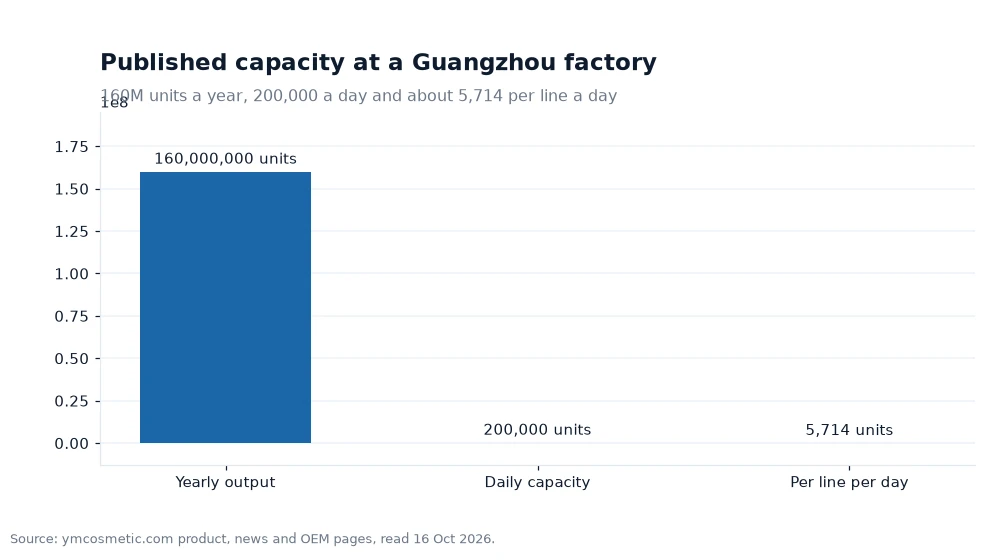
The chart shows three published capacity numbers on a single bar axis, and the scale difference is the first thing a reader notices. Yearly output dwarfs the daily and per-line figures, which is expected: one is a total, one is a rate and one is an average. The chart is a route into the numbers rather than a comparison of them.
The two figures to keep are 200,000 and 5,714. The 200,000 bar is the stated daily capacity, and the 5,714 bar is what one of the 35 lines carries on average. Those two are directly linked, because 5,714 times 35 returns close to 200,000. The 160,000,000 bar sits apart as an annual total and should not be divided by 365 to reach the daily figure, for the reason the worked example shows.
How to read a company page without over-reading it
Read a company page in three passes. First, note the identity lines: legal name, address, what the company says it does. Second, collect the numbers and label each one as a total, a rate, an average or a rate of performance. Third, mark anything that is a company statement rather than a verified fact, including every certification line. That third pass is the one buyers skip most often, and it is the one that prevents an over-read.
To see the published figures in their working context, the manufacturer's colour cosmetics range shows what the capacity is actually applied to. A catalogue alongside a capacity figure makes the profile concrete. Read the pages this way, keep each figure with its label, and a buyer gets an accurate profile instead of an inflated one.
Frequently asked questions
What does the published capacity of Guangzhou Yunmei Cosmetics include?
The pages report 160M units a year and 200,000 units a day across 35 automated production lines, along with a 30,000 square metre factory. The annual and daily figures rest on different bases and should be read as separate statements.
How many units does each production line handle?
Dividing the published daily capacity by the line count gives 200,000 divided by 35, which is about 5,714 units per line per day. Multiplying 5,714 by 35 returns close to 200,000, which confirms the per-line figure.
How long has the company been operating and how far does it ship?
The pages state 21+ years of experience and service to 180+ countries, with a 98.5% on-time delivery figure and a 72-hour response. Reach is a market statement, so a buyer asking about a specific market should request the details for that market.
Close the profile with a question, not a conclusion
A public profile is a starting file, and its job is to tell a buyer what to verify. Note the identity lines, label each figure by type, and keep every certification statement attached to the manufacturer's own published pages. Then ask about the one thing that matters for the order in hand, whether that is a line schedule, a formula or a market requirement. Used this way, the numbers on a company page become a set of questions worth asking a Guangzhou factory, and the answer is more useful than the profile alone.
Published product ranges, factory figures and route windows were read from the manufacturer's pages on 16 Oct 2026.[1]